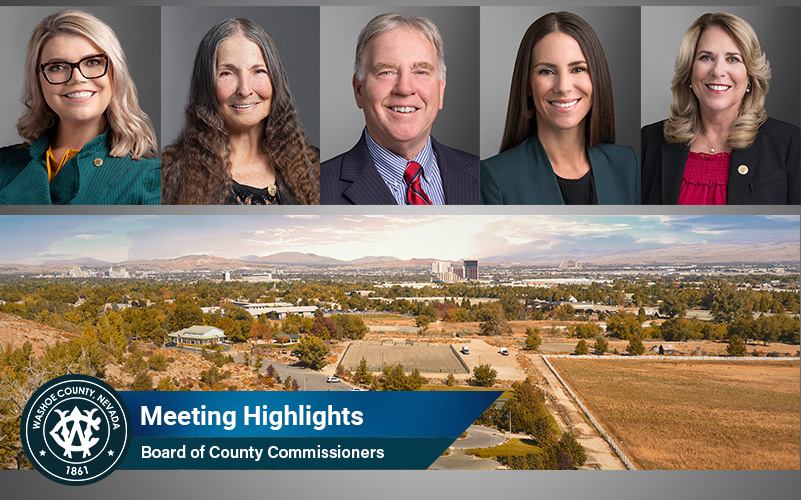
The following are highlights from today’s Washoe County Board of County Commissioners meeting:
1. Blight, RV, and nuisance code amendments: The Board of County Commissioners voted to amend the county code to strengthen code enforcement remedies and increase the rate of compliance. The changes add new tools to address long-running and recurring code enforcement cases including those related to recreational vehicles, junk vehicles, and other common complaints. The amendments expand the definition of “public view” to include public access easements and publicly maintained trails. The changes also increase fines, eliminate discounts for fines after the third penalty, and add new tools to help encourage compliance.
The amendments also remove the language referencing reduction of economic value due to blight. This code language is often cited by complainants as the basis for their complaint; however, potential reduction in economic value cannot be determined in a code enforcement proceeding. A condition or action either violates the code or it does not – perceived economic value is not a code standard.
Finally, the amendments clarify that occupying an RV for more than 30 days is a nuisance. RVs are registered vehicles not permanent dwellings. This code amendment will clarify that it is illegal to use an RV as a permanent dwelling.
“I want to thank our county staff in their efforts to strengthen our Code Enforcement,” Vice Chair Mariluz Garcia said. “This is something that has been a huge priority for this commission, something that’s very near and dear to my heart over the past four years, and you’ll see several items today that are either increasing the Code Enforcement fines or clarifying the definition of blight… Our county staff is working very, very hard, not only those in Code Enforcement but also in Northern Nevada Public Health, and we need to keep going and continue to look at ways to improve these efficiencies because we all want clean and healthy neighborhoods.”
2. Animal Services code amendment: The Board approved amendments to the county code related to animals and fowl to comply with Nevada Assembly Bill 418 (2025) by adding a section requiring a training course on handling pets, renewed every two years, for owners and operators of kennels, animal rescue organizations that handle pets, and commercial establishments engaged in the business of handling pets. The requirement does not extend to veterinarians or animal shelters.
3. Solar project sponsorship: The board accepted a $3,750,000 sponsorship agreement from Google LLC to support the Washoe Solar Project and the installation of solar arrays, battery backup systems, and energy efficiency upgrades at Washoe County facilities. The total cost of the project is estimated at almost $4.5 million, a difference of approximately $707,700, which will be requested in the fiscal year 2028 budget cycle.
A tax credit through the Inflation Reduction Act will generate just over $1.2 million in rebates for Washoe County, if the County can complete construction by the end of calendar year 2027 before the credit expires. The proposed locations are:
- Washoe County Administration Complex, Building A and the Senior Center
- Emergency Operations Center
- Gerlach Community Center and Fire Department
- Sparks Senior Center
- Public Administrator
- Nevada Cares Campus
- Sparks Library
- Downtown Courts lighting control system
“We appreciate Google’s sponsorship of these projects,” Washoe County Sustainability Manager Brian Beffort said. “This investment will bring numerous benefits to the people of Washoe County: lower energy costs, cleaner air, support for renewable-energy jobs, and greater resilience for both our grid and our important community services.”
4. Proclamation: The Board declared November Homeless Youth Awareness Month and presented the proclamation to representatives of the Eddy House, a Reno nonprofit that supports nearly 600 homeless and at-risk youth. It provides emergency shelter, housing programs, counseling, case management, workforce development, and life-skills education to reduce youth homelessness.
###