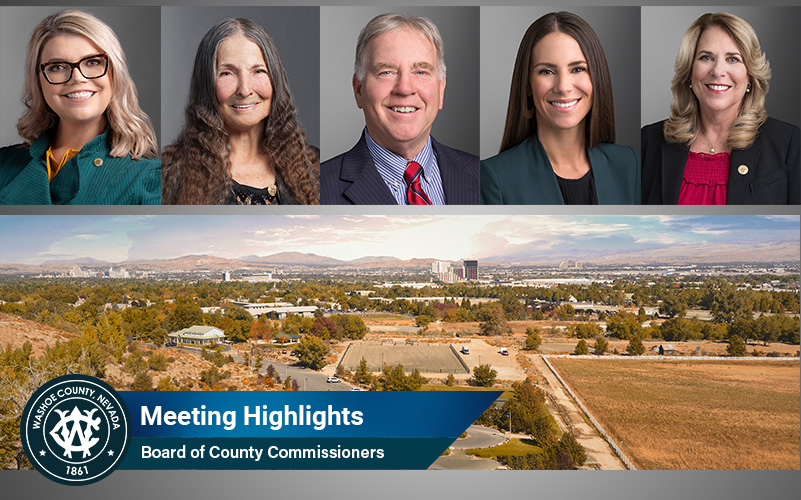
The following are highlights from today’s Washoe County Board of County Commissioners meeting:
1. Board conducts first hearing of ordinance to dissolve Department of Alternative Sentencing: The Board of County Commissioners conducted a first hearing of an ordinance that would repeal County Code Chapter 11, which established the Department of Alternative Sentencing. Chief Financial Officer Abbe Yacoben walked through what led to this action, notably the departure of the DAS chief, three years of an over-spent budget, and an internal audit that found more than 60 deficiencies. In an effort to consistently look for efficiencies, enhance customer service, and improve HR and policy compliance, Yacoben described how disbanding the department and moving certain functions to other departments would achieve these goals.
There are four operational functions that will be moved or addressed in other ways, and 20 positions that serve those functions that will be moved to other departments.
- Drug testing – The Second Judicial District Court (SJDC) is starting a new contract with Averhealth to conduct drug testing. Washoe County will join that contract.
- Pre-trial services – Initial proposal will be provided under the Second Judicial District Court existing program.
- Post-sentence monitoring – Sworn officers will move to the Sheriff’s Office and will continue to collaborate with caseworkers on the post-sentence monitoring while the Justice Courts will receive additional caseworker support.
- STAR Housing and Treatment Program – The program lost its grant for staffing, unrelated to this ordinance, and operations will move to the Human Services Agency, Manager’s Office, and the Sheriff’s Office.
A second reading will be conducted at the November 18 Board of County Commissioners meeting, and a staffing report will be presented at the December 16 meeting, with a full dissolution of the department completed by the beginning of 2026.
“There are still concerns from Reno Justice Court about how we proceed with this new program,” Chair Alexis Hill said. “I am heartened to know that if we vote for it, it won’t be until January, and I’m hoping that if things are not worked out with how we manage the pre-trial services, let’s see if we can extend it to February.”
2. Board hears update on implementation of Raftelis organizational assessment: In June this year, the Board of County Commissioners and staff of the Office of the County Manager were provided a guideline for better communication and effectiveness after a rigorous organizational audit by Raftelis consulting firm. A series of 12 recommendations are scheduled for implementation through June 2027, and today Interim County Manager Kate Thomas provided an update on the status of implementation. Since June, the Office of the County Manager has created more frequent meetings and briefings with Commissioners and has realigned some of its reporting structure. Still in progress is a process for prioritizing Commissioner requests to staff, setting a cadence for Board meetings and workshops, conducting more thorough onboarding, and working on ways to strengthen Board relationships, accountability and collaboration. Two items on hold are strategic planning and finalizing the restructure of the Office of the County Manager, which is expected to be addressed after a new County Manager is appointed.
“We’re happy to report that we started some initiatives right away,” Thomas said. “You’ve been seeing the weekly Board Brief. Rather than getting a multitude of emails, we’re trying to communicate in a more meaningful way by putting that into a weekly publication for you that also goes out to our elected department heads, other department heads, and out to the county organization.”
In December, the Board will conduct a retreat to lay the foundation for roles, responsibilities, and best practices for the organizations. Other workshops are planned in the first quarter of 2026 to further Board collaboration.
“It’s good to see some progress, and a lot of this we cover in our one-on-one, so it was no surprise,” Commissioner Mike Clark said. “So it’s nice to see it all in one presentation.”
3. Board provides direction on priorities in Master Plan: The Envision Washoe 2040 Master Plan sets the policy-level vision that guides future growth and development in the unincorporated County. Planning and Building Division Director Kelly Mullin presented an update on the Master Plan that was adopted in November 2023. There were seven specific initiatives that the Board identified as top priorities, four of which have been completed or are being addressed elsewhere in the county. Those are: resources to implement the Master Plan, the Tahoe Area Plan, Warm Springs groundwater rights, and dashboard indicators for measuring plan achievements.
Three new topics were introduced for prioritization: Heat mitigation (required by the 2025 Nevada Legislature), Dark Skies, and Agritourism.
The Board voted unanimously to prioritize the initiatives in the following order:
- Countywide affordable housing initiatives
- Equine businesses
- Agritourism
- Heat mitigation
- Dark Skies
- Public noticing
4. Board declares this week National Friends of the Library Week: This week, October 19-25, was recognized as National Friends of the Library Week. The Washoe County Library System operates 12 branches with more than 130 employees. It serves the entire county, even those who do not live near a library branch by offering a Bookmobile.
5. Board approves donation to the Reading Room Project: The Reno Rodeo Foundation donated books and stuffed animals valued at approximately $8,200 to support the Reading Room Project, a project developed by the Second Judicial District Court to provide a friendlier and warmer space for children and families attending court. The Reno Rodeo Foundation provides ongoing donations of books, toys, and teddy bears to ensure each child who comes to court can leave with an item. The Reading Room Project also received $250 in donations from anonymous donors.
“A court is not necessarily the most friendly environment for our smallest and most vulnerable patrons, and those books serve as a celebratory memento for children who are on our adoption docket,” District Court Administrator Alicia Lerud said. “They serve as a way for children to walk away from the court with a positive experience. It really changes how a child walks away from the courthouse.”
6. Board approves allocations of District 3 and District 5 Special Funds: Commissioner Mariluz Garcia allocated $2,500 from the District 3 Special Fund to Desert Pigs, a nonprofit group of volunteers who clean up illegal dump sites on public land. Commissioner Jeanne Herman allocated $5,000 from the District 5 Special Fund to Senior ResQ, a nonprofit organization that assists senior citizens when their rents have been raised.
###