Washoe County and Truckee Meadows Fire Protection District frequently receive complaints regarding weeds, invasive species, and hazardous fuels. Although these terms are frequently used interchangeably, they describe different issues. The following guide explains how to tell them apart.
- Noxious Weeds: Technically, “weeds” are any plant growing where it is not wanted and in competition with cultivated and/or native We usually refer to weeds in Nevada as noxious, which means any species of plant which is, or is likely to be, a public nuisance, detrimental, or destructive and difficult to control (see NRS 555).
- Invasive Species: Are non-native plants introduced from outside Washoe County that can overtake landscapes. The best example of an invasive species is Cheatgrass (Bromus tectorum). This is a Eurasian plant that was introduced to North America in the mid-1800’s. While it is usually considered a weed, it is so endemic and aggressive in Nevada, it is not a subject of noxious weed control measures.
- Hazardous Fuels: In fire prevention terms, this may include weeds and invasive species but refers to any vegetation, which can be native, invasive, or landscaped, that poses a hazard to a person’s property or structure. These types of fuels can be more subjective, which makes management more specific and using these terms interchangeably can lead to confusion, as each has distinct implications for management and enforcement.
References
- Noxious Weeds: https://agri.nv.gov/Plant/Noxious_Weeds/Noxious_Weed_List/
- Hazardous Fuels Guidelines: https://www.livingwithfire.org/get-prepared/how-to-improve-my-defensible-space/
Applicable Codes and Enforcement
- County Code: https://www.washoecounty.gov/csd/planning_and_development/code_enforcement/index.php
- WUI Code: https://codes.iccsafe.org/content/IWUIC2024P1
Pertinent NRS
- NRS 555 – Relates to Nevada Department of Agriculture and noxious weed control
- NRS 472 and 528 – Relates to Nevada Division of Forestry and forest practices
- NRS 474 – Relates to Fire Protection District roles, responsibilities, and authorities
From the Fire District’s perspective, TMFPD has adopted the International Wildland Urban Interface Code (IWUIC) and is currently operating under the 2024 edition. This code provides general guidelines for defensible space but does not specify plant species. It also includes requirements for tree spacing and limb separation from structures (10 feet for both), applying to both landscaped and natural vegetation.
Currently, the WUI Code does not apply to structures built prior to TMFPD’s adoption of the code and is not retroactive for pre-existing homes within the Truckee Meadows Fire Protection District. Only new homes and homes with additions or building permits in high-risk areas will need to comply with defensible space requirements dictated by the IWUIC.
How You Can Prepare Your Home
- Home Hardening Improvements
-
- Replace combustible siding with new, non-combustible materials (i.e. stucco, concrete board)
- Ensure the roof is a non-combustible material and in good
- Replace existing eave/crawlspace vents with 1/8-inch metal mesh or ember-proof type
- Improve decks/porches to be constructed in accordance with IWUIC or replaced with
- Ensure rain gutters are clear of debris and made of non-combustible
- Enclose soffits (underside of eaves) with fire-resistant
- Convert wood fence materials to non-combustible (metal or composite) where attached to
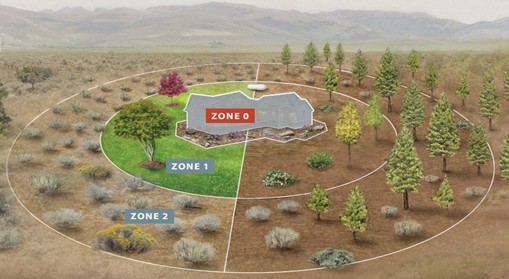
- Ember-resistant Zone 0 (0-5 feet)
- Remove all vegetation or combustible materials within this Remove debris regularly.
- Lean Clean and Green Zone 1 (5-30 feet)
- Create fuel breaks with driveways, walkways, and paths using hardscape Limit the use of bark mulch, especially near the home.
- Keep lawn and grasses mowed to a height of four
- Keep plants in this zone well irrigated throughout the dry, summer
- Favor deciduous trees and shrubs over evergreen plants in this
- Remove vegetation from under trees and prune branches within six feet of the For shorter trees, don’t prune more than 1/3 of their total height.
- Space tree canopies to have a minimum of 10 feet between crowns (branch ends) and 10 feet from roof
- Store firewood at least 30 feet from the
- Reduced Fuel Zone 2 (30-100+ feet)
- Remove all dead trees and
- Remove vegetation growing beneath the mature trees and any limbs below 6
- Remove vegetation adjacent to storage buildings or other outbuildings
**** Specifics relating to types of vegetation, appropriate mitigation, and available assistance/enforcement vary by site. For recommendations and information related to a specific parcel or site, please reach out to TMFPD at (775) 326-6000. Experts focused in this field will schedule a time to see your specific location in person and give recommendations.