
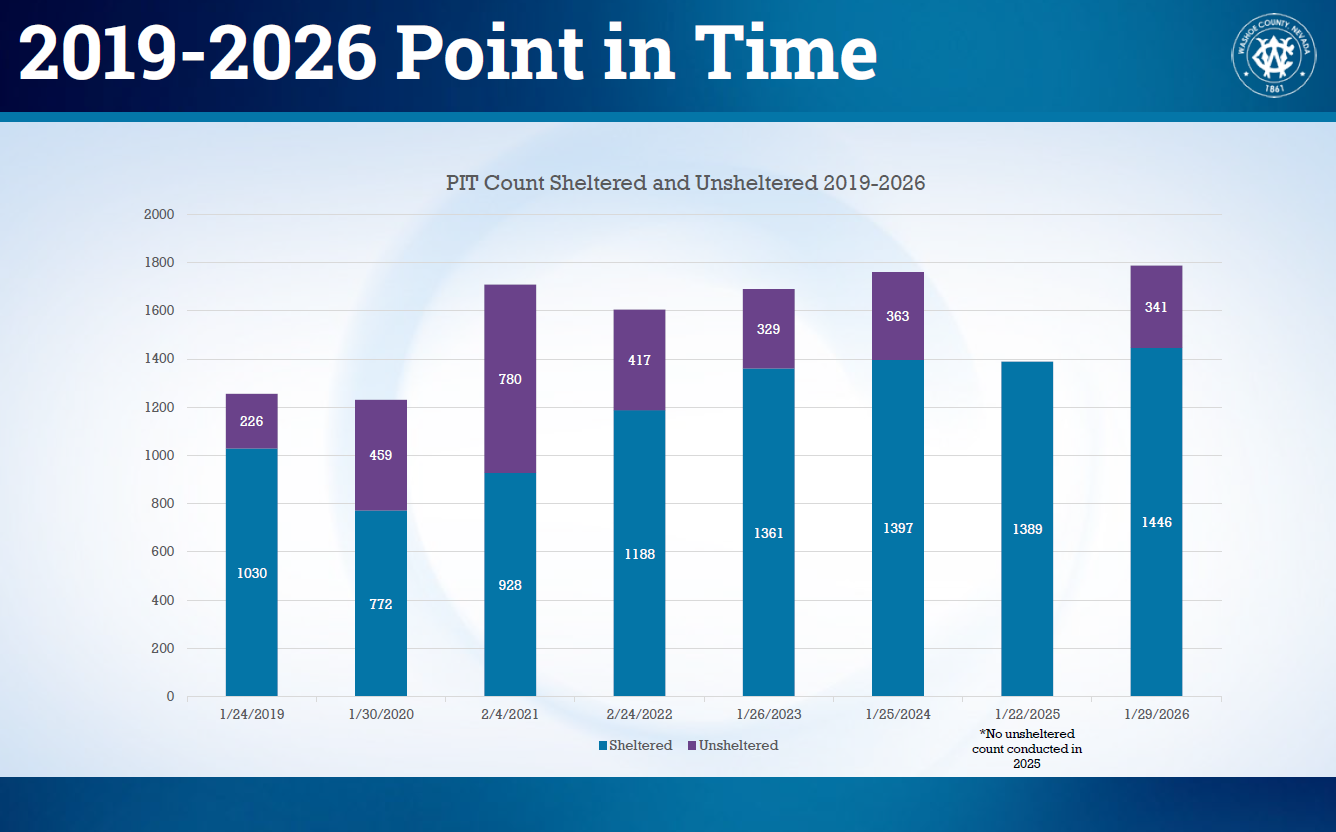
Five years ago, our community counted 780 people living unsheltered in Washoe County. This year, that number is 341, a 56 percent reduction. We have done this while our region has continued to grow. At the same time, the 2026 Point-in-Time (PIT) Count provides a stark reminder of both the successes and the remaining challenges our community faces in combating homelessness.
Travis Sandefur, division director of Housing and Homeless Services
While unsheltered homelessness dropped another 6 percent from 2024, the total homeless population grew 1.5 percent. We have bent the trajectory, but to succeed, we must break it. We have stabilized a crisis, and now we must recommit to ending homelessness as we know it.
For our team, the goal is zero. Zero people unsheltered. Zero people homeless. We can never lose sight of that. One thousand, seven hundred, and eighty-seven people, including those sheltered, are still homeless. That is a staggering and unacceptable number because behind the numbers are precious humans, our neighbors. While confronting the brutal facts of the challenge, we must also celebrate successes, especially the person-by-person victories. Against the odds, we have held the line. While other communities have lost ground, we have gained ground. And we will not give it back. Make no mistake, the toughest work lies ahead as we encounter humans with the most complex needs, but we have the infrastructure to take it on.
But before charting that path forward, it is worth looking at the tool itself. The PIT Count is often cited and rarely understood. The gap between what it measures and what people assume it measures is where the narratives diverge. Misunderstanding leads to both the “we’re losing” cynicism that dismisses real progress and the “we’re winning” overconfidence that declares premature victory. To know what the numbers are telling us, and what they aren’t, we have to start with what the count actually is. The PIT Count is required by the U.S. Department of Housing and Urban Development (HUD). Each year, communities must count people experiencing sheltered homelessness, and every other year, those experiencing unsheltered homelessness. The count is not exact, and results can vary significantly based on external factors such as weather.
The sheltered count is relatively straightforward. Using the Homeless Management Information System (HMIS), the community takes a snapshot of individuals using shelters and non-permanent housing programs. With over 90 percent of partners in the region using this system, our confidence is growing that it captures the reality.
The unsheltered count requires legwork. The community needs to go find individuals whose “primary nighttime residence is a public place not ordinarily used for sleeping accommodation”: cars, parks, bus stations, etc. This year, we had more than 60 trained individuals scour the region to identify those individuals. The Washoe County Sheriff’s Office and the HOPE team were instrumental in making this our most comprehensive effort to date.
Despite the limitations, the PIT count remains a vital tool. It provides a rare glimpse into the unsheltered population that all too often remains elusive and hidden. Having a single tool with a consistent, though imperfect methodology, provides a nationwide snapshot in a way that other ad hoc singular approaches would not. The National Alliance to End Homelessness contends that it is still the most reliable estimate of people experiencing homelessness.
While on its own, a single year’s PIT data offers limited insight, when viewed over a five-year period, it can begin to outline a broader picture. For instance, our community saw a huge number of unsheltered individuals during the Covid-era which necessitated the building of more emergency shelter capacity. Even as that unsheltered number dropped, we began to see a stable number of individuals not utilizing the shelter. This informed an emphasis on increased outreach teams to meet those individuals where they were at in an effort to get them straight into housing or the shelter as appropriate.
Instead of abandoning the PIT Count, we can continue to improve and supplement the PIT Count. An American Journal of Public Health paper on the PIT Count recommends against treating the PIT count as a standalone metric, instead positioning it as a foundation that should be supplemented. We have bolstered training for counters and enhanced technology to create consistency and thoroughness. Our teams use a GPS-enabled phone app for the unsheltered count, and the HOPE team added the use of drone technology to map hard-to-reach encampments.
Beyond the PIT Count, HMIS provides a rich data source. HMIS is a database updated whenever someone experiencing homelessness interacts with support services.
Participation is voluntary, and until about three years ago, only a small percentage of organizations in our region used it consistently. Washoe County has relentlessly encouraged participation in this system to better work together toward targeted solutions. In 2023, we reached a major milestone: more than 90 percent of organizations serving people experiencing homelessness began using HMIS.
This is known as “quality by-name data.” Rather than offering a snapshot from a single day, HMIS allows us to see how individuals interact with services over time. It shows, for example, that someone saw a doctor last week, checked into a shelter yesterday, and met with a case manager today. This longitudinal view provides a far more complete and accurate understanding of homelessness in our community.
The path ahead is difficult, but it is not hopeless. Our community has a multi-prong strategy to meet the moment. First, we must continue to shelter the remaining unsheltered individuals. By getting them sheltered, we not only address their immediate health and safety but also provide them with wraparound services: case management, primary care treatment, mental health counseling, substance abuse treatment, and job and life skills training.
Second, we need to build the supportive housing pipeline. So many of those we serve have complex physical and mental health needs. Housing alone will not be enough – many will need continued wraparound services to varying degrees. A regional assessment done in 2023 indicates that we will still need more than 1,000 units for this type of housing and services for our most acute individuals. We have a model that works, but have not yet built it at the scale required.
Third, we need more affordable housing. I spoke at a class at UNR recently and asked how many of the students were concerned about the cost of housing upon graduation. Every hand went up. The City of Reno’s dashboard shows that we especially need housing that is attainable for very low-income folks, those making 30 percent of the Area Median Income (AMI). Lastly, we must cut off the pipeline of people falling into homelessness every year. As we have stabilized the crisis, we must now pivot upstream to prevention.
While copy and paste solutions from one community to another are ill advised, Washoe County’s approach can still be instructive for other regions. Data collection is vital. Even imperfect data will show the scale of homelessness, utilization of current resources, and provide targeted solutions. For instance, targeting the segment of housing that is in shortest supply, and building emergency shelter capacity appropriate for that region.
The lesson here is not just the specific programs but the architecture that holds them together. The conversations I have most often with peers in other regions center on frustration that a single tool is not solving the crisis. The temptation is to abandon that tool and swing toward the next idea. The siren call of the silver bullet tempts us all. But in our experience, no single piece of the system works alone. What works is the layering.
In our system, emergency shelter campuses serve as hubs. They provide a place to sleep, store essential belongings, food, and laundry. These provide a critical respite from unsheltered life. But a bed alone is not enough, so we layer in wraparound services: case management, primary care, mental health counseling, and substance abuse treatment, all on-site. Even this is not enough on its own. It is a critical enhancement to the continuum but does not in and of itself solve homelessness.
Around that hub, our region has layered additional services to reach people whose needs the hub alone cannot meet. Many of those we serve have complex physical and mental health needs that traditional housing placement cannot address. With help from the Nevada Housing Division, our community has invested heavily in supportive housing that pairs affordable housing with necessary services to ensure wellbeing and stability. At the Cares Campus permanent supportive housing building, an Assertive Community Treatment (ACT) team of psychiatric clinicians, peer support specialists, case managers, and substance abuse counselors works on-site. This provides person-centered care rather than referring people to disconnected resources.
The outermost layer reaches the people who have not come to the hub at all. Outreach teams from the City of Reno, Sparks, Washoe County, and the Sheriff’s Office work the streets, the riverbeds, and the encampments, engaging people there, building rapport, and working toward person-centered housing plans. Affordable housing is the goal. The hub holds the center. Supportive housing holds those whose needs exceed it. Outreach holds the edges. None of these layers works alone. And none of this works in full without somewhere for people to move into.
No matter the tools a community brings to bear, a level of humility and willingness to pivot are essential. We continue to look at solutions in other communities and tweak programming where we can. We all must continue to grapple with seemingly intractable problems: Why are more families experiencing homelessness? How is society going to serve an aging population in need of more care? What role do the shortage of affordable housing and the lack of adequate behavioral healthcare play in these trends?
I am deeply grateful to the organizations, jurisdictions, and community members who have stepped forward to address the crisis of a generation. Many of those helped with our latest PIT Count, which not only fulfilled a federal requirement, but also provided us a clearer picture of homelessness in our region.
I would challenge you to look beyond the headlines and think critically about the data. I fear we have lost the art of nuance, but challenges like this require it. There is no silver bullet. There is only the person-by-person work. And I would challenge you to remember that behind every number is a human being. Humans are messy, but beautifully valuable. I have seen lives transformed. I know you will, too.
If you want to learn more about the work underway, contact Washoe County’s Housing and Homeless Services Division. The path ahead is difficult, but we will continue to walk together as a region.